M.Sc (CSDA) (Five Year Integrated Course)
| Programme Offered |
Duration (Years) |
Sanctioned Seats |
Reserved Categories ** |
| SC |
BC |
ExS-GN |
ExS-SC |
ExS-BC |
FF-GN |
PWD |
SportsGen/ SportsSC |
| B.Sc. (Computational Statistics and Data Analytics) |
3 |
40 |
8 |
3 |
3 |
2 |
1 |
0 |
1 |
1 |
| B.Sc. (Honours) (Computational Statistics and Data Analytics)
|
4 |
| B.Sc. (Honours with Research) (Computational Statistics and Data
Analytics) |
4 |
| M.Sc. (Computational Statistics and Data Analytics) (FYIP) |
5 |
- Senior Secondary Examination (12 grade) with Medical with
Mathematics/ Non-Medical/ Commerce/ Humanities with Mathematics with
at least 50% marks (45% for SC) inaggregate or any other examination
recognized equivalent thereto by GND University, Amritsar.
Admission will be based on merit of the candidate in the
Entrance Test to be conducted by the Coordinator.
M.Sc (CSDA) (Two Year Programme)
| Programme Offered |
Duration (Years) |
Sanctioned Seats |
Reserved Categories ** |
| SC |
BC |
ExS-GN |
ExS-SC/ExS-BC |
FF-GN/PWD |
SportsGen/SC |
| P.G. Diploma in Computational Statistics and Data Analytics |
1 |
20 |
4 |
2 |
1 |
1 |
1 |
1 |
| M.Sc Computational Statistics and Data Analytics |
2 |
- B.Sc(Computational Statistics and Data
Analytics)/BBA/B.com./B.Sc.(Hons.) Economics or Graduate in any
stream with Mathematics/Statistics/ Computer Sciences/Computer
Applications/IT/Computer Maintenance/Quantitative Techniques as one
of the elective subjects with 50% marks(45% for SC) in aggregate or
any equivalent Degree thereto.
Admission will be based on merit of the candidate in
Entrance Test to be conducted by the University.
Research Activities/niche area
Activities
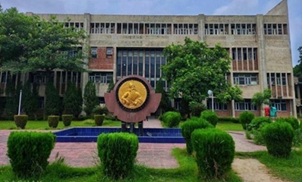 The
Department of Computational Statistics & Data Analytics was
established in July 2020 at Guru Nanak Dev University inside the
Maharaja Ranjit Singh Bhawan building. The Department is dedicated
to fostering excellence in the dynamic and rapidly evolving field of
Data Science. Our aim is to equip students with cutting-edge skills
and knowledge, enabling them to interpret and utilise the vast
streams of scientific, social, and financial data generated every
second. We aim to be a vibrant research hub, promoting
interdisciplinary collaboration and innovation in data analysis and
utilisation.
The Department currently offers two main academic tracks under
the CSDA framework: the M.Sc. (Computational Statistics & Data
Analytics) [Five-Year Integrated Programme] and the M.Sc.
(Computational Statistics & Data Analytics) [Two-Year
Programme]. These tracks are further structured into various
exit and specialization points in accordance with the National
Education Policy (NEP) 2020 guidelines, offering flexibility and
multiple career paths to students. In addition, the curriculum
emphasizes computational and analytical techniques that are
essential in modern data science. Courses in statistical computing,
optimization techniques, simulation, and programming with C++, R and
Python ensure that students are proficient in both theory and
practical implementation. Advanced topics like machine learning,
data mining, and high-dimensional data analysis prepare students to
work with complex data systems and algorithms.
The
Department of Computational Statistics & Data Analytics was
established in July 2020 at Guru Nanak Dev University inside the
Maharaja Ranjit Singh Bhawan building. The Department is dedicated
to fostering excellence in the dynamic and rapidly evolving field of
Data Science. Our aim is to equip students with cutting-edge skills
and knowledge, enabling them to interpret and utilise the vast
streams of scientific, social, and financial data generated every
second. We aim to be a vibrant research hub, promoting
interdisciplinary collaboration and innovation in data analysis and
utilisation.
The Department currently offers two main academic tracks under
the CSDA framework: the M.Sc. (Computational Statistics & Data
Analytics) [Five-Year Integrated Programme] and the M.Sc.
(Computational Statistics & Data Analytics) [Two-Year
Programme]. These tracks are further structured into various
exit and specialization points in accordance with the National
Education Policy (NEP) 2020 guidelines, offering flexibility and
multiple career paths to students. In addition, the curriculum
emphasizes computational and analytical techniques that are
essential in modern data science. Courses in statistical computing,
optimization techniques, simulation, and programming with C++, R and
Python ensure that students are proficient in both theory and
practical implementation. Advanced topics like machine learning,
data mining, and high-dimensional data analysis prepare students to
work with complex data systems and algorithms.
The programmes also include contemporary subjects in data science
and emerging technologies such as big data analytics, deep
learning, natural language processing (NLP), and Internet of Things
(IoT) analytics.
To support this learning students receive training in widely-used
software and tools, including R, Python, MATLAB, SQL/NoSQL
databases, Tableau, Power BI, Hadoop, and SPSS. These tools form the
technological backbone of the program, ensuring that graduates are
industry-ready and competent with current technologies.
In summary, the CSDA programs offered by the Department provide a
rigorous, future-focused education designed to develop the next
generation of data professionals. With a balance of theoretical
depth, computational skill, and applied learning, graduates are
well-equipped to succeed in dynamic roles such as Data Scientist,
Machine Learning Engineer, Business Analyst, Data Engineer, and AI
Researcher, among others. The flexible program design also enables
students to enter or exit at various points with recognized
qualifications, ensuring academic mobility and relevance in the
evolving data-driven world.